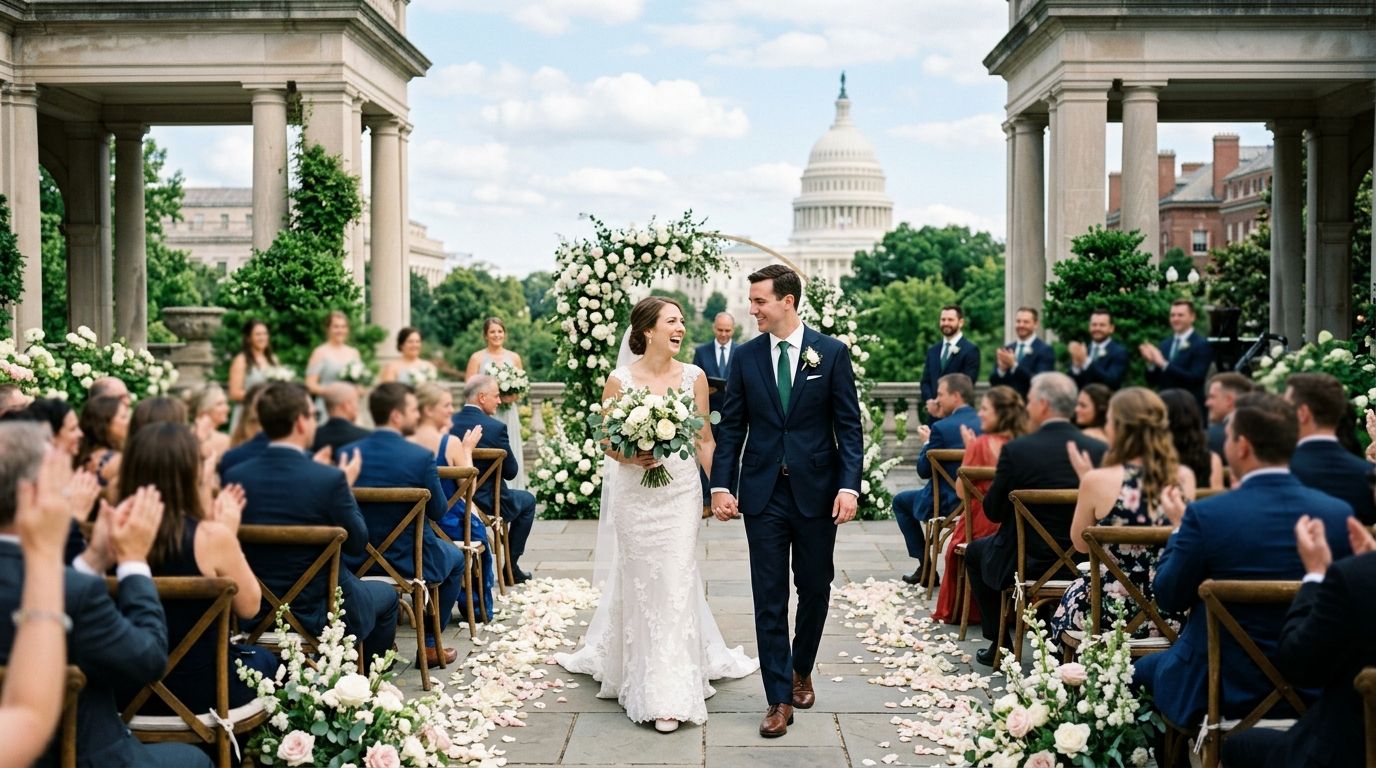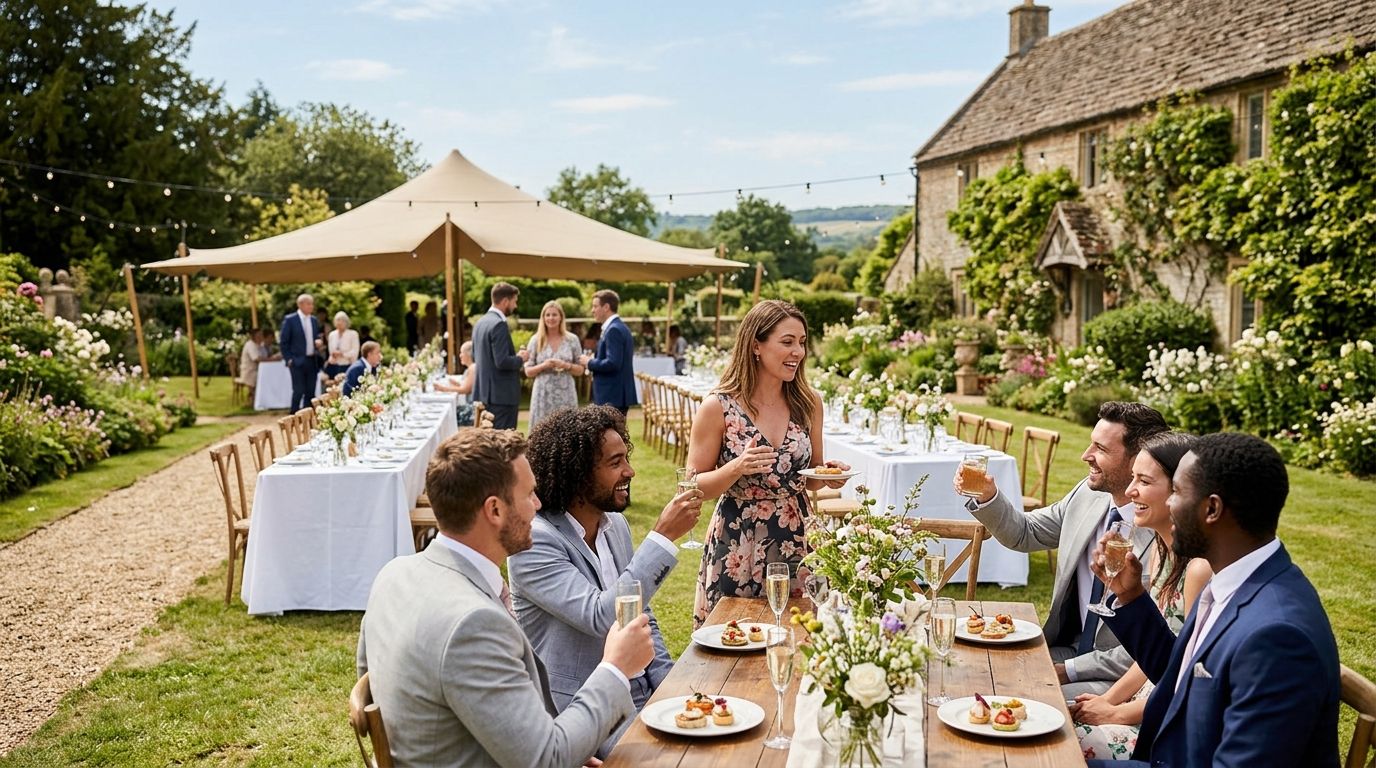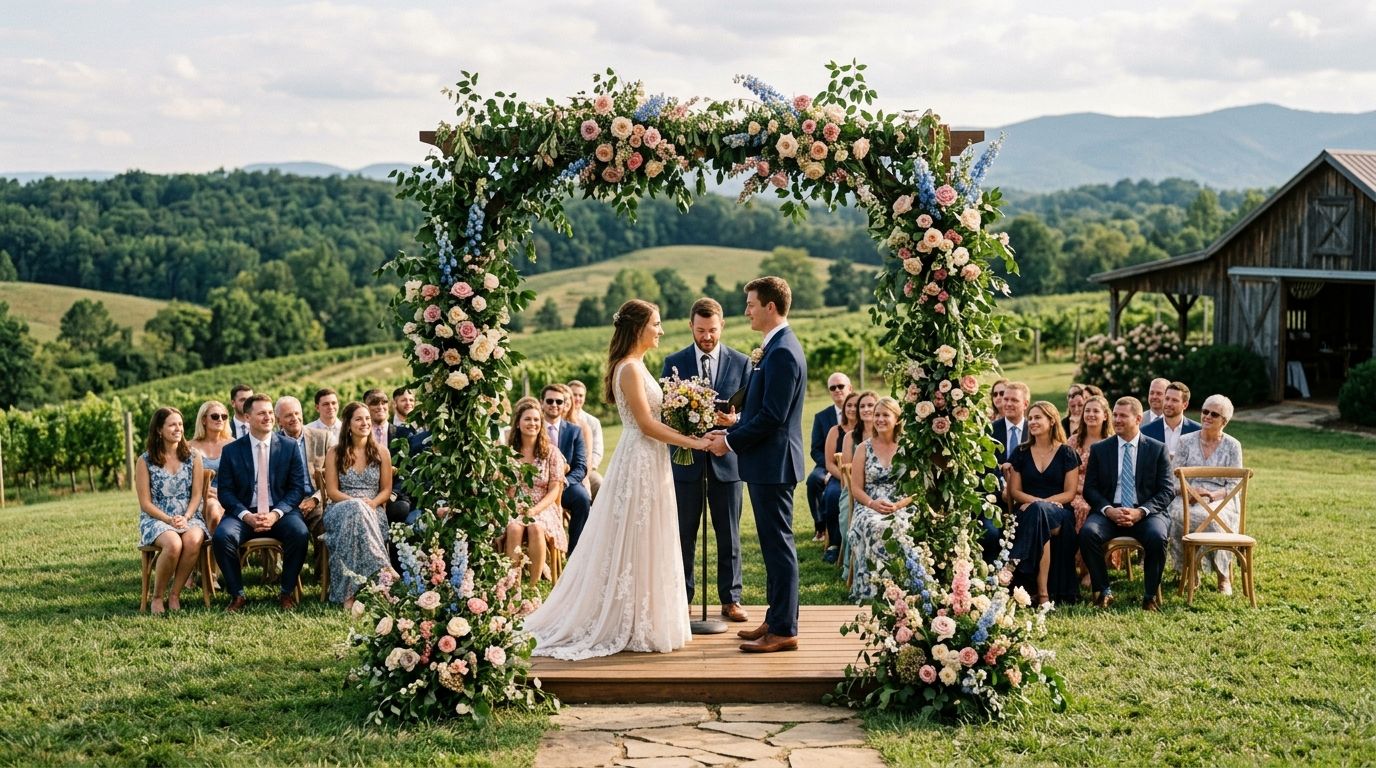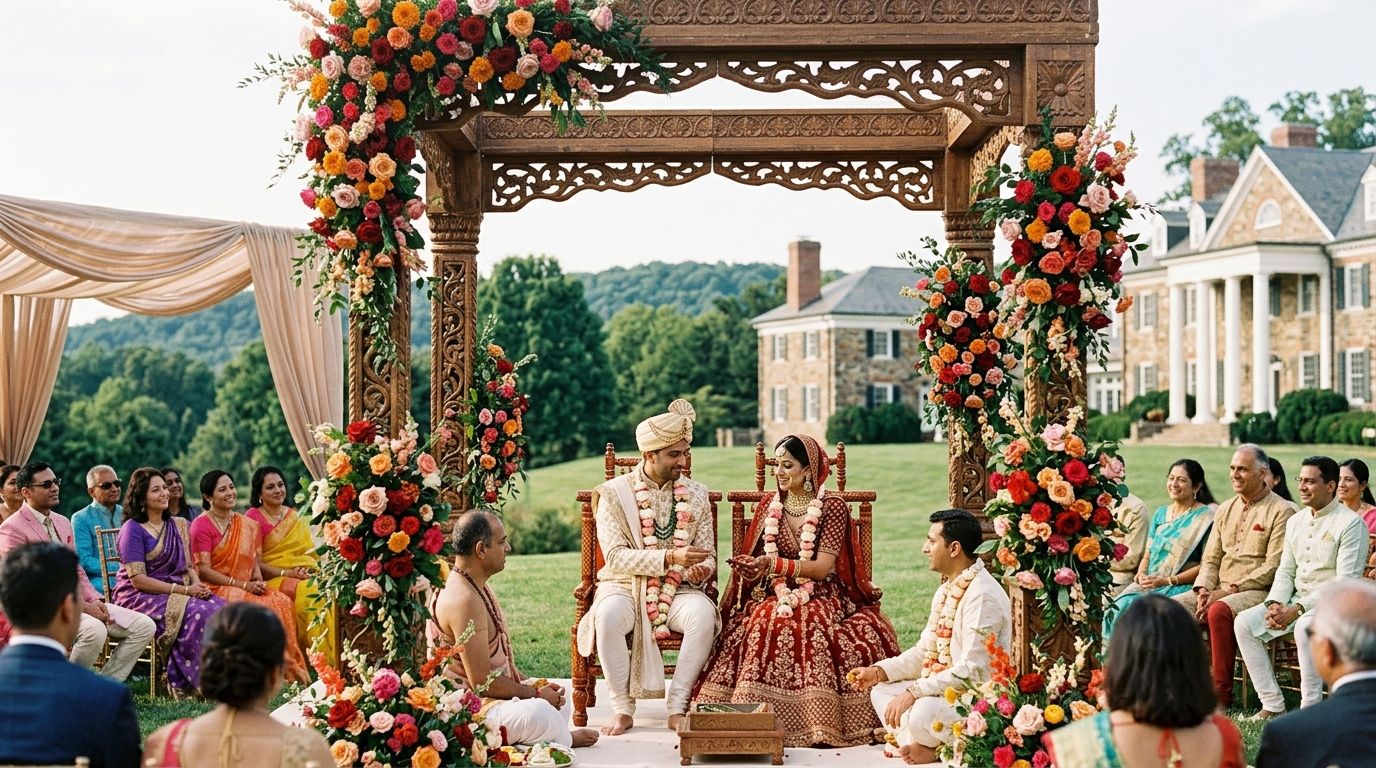
South Asian wedding venues in Virginia need to handle more than a single ceremony and reception — they need room for a baraat, a mandap or stage setup, a sangeet, and often 250 to 400+ guests across two or three days. This guide breaks down what to check before booking, what a Georgian manor estate like Great Marsh Estate can and can't do for a South Asian wedding, and where the common booking mistakes happen.
- South Asian wedding venues in Virginia need multi-day flexibility, outdoor space for a baraat, and prep rooms for two families at once.
- Great Marsh Estate in Bealeton, VA hosts up to 200 guests — workable for many South Asian weddings, a hard ceiling for larger ones.
- Courtyard ceremony sites plus a restored 1800s stables reception hall give you separate ceremony and reception spaces.
- Confirm outside catering policy, open-flame rules, and noise allowances for dhol drums before signing in 2026.
- Book prep suites for both families early — a bridal suite and groom's lounge matter more on multi-ceremony days.
Why this matters for South Asian weddings
A South Asian wedding isn't one event on one afternoon. It's often a mehndi night, a sangeet, a baraat procession, a religious ceremony (Hindu, Sikh, Muslim, Jain, or interfaith), and a reception — sometimes spread across two or three days at the same property. That changes what venue capacity and venue layout actually mean.
A hall built for a four-hour reception timeline doesn't automatically work for a wedding that needs a long ceremony plus reception turnover, plus outdoor space for a drum-and-dance procession arriving at the ceremony site. Couples searching for south asian wedding venues virginia in 2026 should filter for multi-space layouts first and aesthetics second.
Confirm your guest count against venue capacity
South Asian guest lists commonly run larger than the Virginia average — combined family, community, and business invites push many events past 300 people. Get a real headcount before you tour anywhere.
- Count guests separately for the ceremony, the reception, and any sangeet or mehndi event, since families often invite different-sized groups to each.
- Ask every venue for its maximum seated capacity, not just its stated event capacity — those numbers differ once a mandap or stage eats into floor space.
- Confirm whether outdoor ceremony space counts toward or against the indoor reception cap.
- Build in a buffer of 10-15% for the late additions common to South Asian guest lists.
Great Marsh Estate hosts weddings for up to 200 guests in Bealeton, Virginia. That number works for many South Asian weddings and stops hard above it — check it against your real list before you fall in love with the courtyard.
Choose a venue with distinct spaces for each ceremony
One room doing double duty as ceremony site and reception hall means a mid-event furniture flip while 200 guests wait around. Separate spaces solve that.
- Look for a dedicated outdoor or covered ceremony area separate from the reception room.
- Ask if the venue permits a mandap, stage, or fire setup on the ceremony site.
- Confirm whether vendors can set up the reception space while the ceremony runs elsewhere on the property.
- Check shade and sightlines for a midday outdoor ceremony, which is common when timing follows an auspicious window.
Great Marsh Estate pairs courtyard ceremony sites with a restored 1800s stables reception hall — a layout that supports an outdoor mandap or stage while keeping the reception in a fully separate room.
Confirm fire, smoke, and processional rules in writing
Hindu and Jain ceremonies often include a fire ritual; a Sikh Anand Karaj is typically indoors around the Guru Granth Sahib; baraat processions arrive with dhol drummers, dancing, and sometimes a horse or decorated vehicle. Venues handle all of this differently.
- Ask directly whether open flame is permitted, and whether the venue requires a fire marshal sign-off or insurance rider.
- Confirm whether outdoor amplified music has a curfew tied to local noise ordinances.
- Check that the approach or driveway is wide enough for a procession to arrive with dancing and drumming intact.
- Get restrictions on rice, flower petals, or colored powder in writing — historic properties sometimes limit these to protect period structures.
Fauquier County, where Bealeton sits, is rural enough that outdoor processions and drumming are rarely the conflict point they become at venues wedged into dense residential blocks closer to Washington, D.C.
Lock down catering flexibility for multi-cuisine service
Authentic South Asian catering — regional Indian, Pakistani, Bangladeshi, or Sri Lankan menus, halal or Jain dietary requirements — usually means bringing in a specialist caterer rather than using an in-house kitchen built for standard American wedding fare.
- Ask whether outside catering is allowed, and whether there's an approved-vendor list or an open-caterer policy.
- Confirm kitchen access: warming space, prep counters, and whether the caterer can bring their own equipment.
- Check that the venue's timeline supports the longer cooking and service window multi-course menus need.
- Get cleanup responsibilities in writing when an outside team runs the kitchen.
Reserve separate prep spaces for both families
Multi-ceremony South Asian weddings usually have two families getting ready at the same time — one side doing mehndi touch-ups and sari draping, the other on sherwani fittings and turban tying.
- Confirm there are at least two separate getting-ready spaces, not one room split by a curtain.
- Ask about mirror, outlet, and seating counts in each space for teams working on several people at once.
- Check whether each space holds the family members who gather during mehndi application, which can run for hours.
- Confirm morning access — can both spaces open at the same time, or does one family arrive earlier?
Great Marsh Estate includes a bridal suite and a groom's lounge, giving each side of the family its own space to prepare. That detail matters far more on a multi-ceremony day than on a single-ceremony timeline.
See if the estate fits your celebration
Tour the courtyard, stables hall, and prep suites before you commit to a date.
Get vendor and rental terms in writing before you sign
Mandap structures, stage risers, drapery, and specialty lighting are almost always rented separately from whatever the venue provides by default.
- Ask whether outside decor and structural rental vendors are allowed, and what the load-in window is.
- Confirm ceiling height and floor load limits if you're bringing in a large mandap or stage.
- Check whether venue furniture and linens are included or need swapping for your rental order.
- Get the teardown cutoff in writing — historic properties often require full breakdown by a set hour.
Comparing venue types for South Asian weddings in Virginia
| Venue type | Best for | Key limitation |
|---|---|---|
| Historic estate or manor (e.g. Great Marsh Estate) | Couples wanting a distinct outdoor ceremony site plus a separate indoor reception hall | Capped guest count — 200 at Great Marsh Estate, tight above that |
| Banquet hall | Large guest counts in one flexible room | Usually one shared space, so a ceremony-to-reception flip is required |
| Hotel ballroom | Out-of-town guests who want lodging on site | Limited or no outdoor space for a baraat procession |
| Farm or barn venue | Rustic look with open outdoor grounds | Kitchen setups often built for simpler menus, not multi-cuisine service |
Verdict: Great Marsh Estate is the strongest fit for South Asian weddings at or under 200 guests that want a genuine outdoor ceremony site paired with a separate reception hall — couples planning for 250 or more should be looking at banquet halls or larger estate properties instead.
Common mistakes South Asian couples make when booking
- Booking before confirming the real guest count. Family-driven lists grow late in planning, and a venue that seats 180 comfortably at signing feels packed at 220.
- Assuming any outdoor space works for a baraat. Narrow driveways and landscaped photo paths bottleneck when 40 or more people arrive dancing and drumming.
- Leaving the catering conversation until after the deposit. Some venues restrict outside caterers or gate kitchen access — find out before the mandap is booked.
- Underestimating prep space. One shared getting-ready room fails when mehndi, draping, and turban tying all happen the same morning.
- Ignoring teardown time against a multi-ceremony timeline. A day that runs ceremony into reception into late dancing needs a vendor cutoff that matches it.
FAQ
What's the best wedding venue for a South Asian wedding in Virginia?
It depends on guest count and ceremony structure. Great Marsh Estate in Bealeton, VA fits South Asian weddings up to 200 guests that want a separate outdoor ceremony site and an indoor reception hall; larger weddings need a higher-capacity banquet hall.
How many guests do South Asian weddings usually have?
South Asian weddings in the U.S. commonly run from 200 to 400 or more guests across combined family and community invites, larger than the average Virginia wedding. Confirm your real headcount before booking any venue with a fixed cap.
Can a historic estate host a baraat or mandap ceremony?
Many historic estates allow outdoor mandap setups and baraat arrivals, but rules on amplified music, open flame, and driveway access vary by property. Ask the venue directly in 2026 rather than assuming.
Do South Asian weddings need outside catering?
Most do, because regional Indian, Pakistani, Bangladeshi, and Sri Lankan menus need specialist caterers rather than a venue's in-house kitchen. Confirm the outside-catering policy before you sign.
Is a 200-guest capacity enough for a South Asian wedding?
For many, yes. Two hundred guests covers smaller and immediate-family-focused South Asian weddings, but lists that include extended community and business contacts often run past it.
How much space does a South Asian wedding reception need?
You need seated dinner service plus a dance floor large enough for group dancing. A separate ceremony space keeps mandap or stage structures from compressing the reception layout.
What's the difference between a mandap and a reception stage?
A mandap is a structured canopy used for Hindu and Jain wedding ceremonies, usually outdoors or in a dedicated ceremony space. A reception stage is decorative seating for the couple during a reception or sangeet, typically indoors.
Are noise ordinances a problem for baraat processions in Virginia?
Rural venues in counties like Fauquier generally face fewer restrictions on outdoor drumming and amplified music than venues near dense residential areas. Curfews still vary by locality, so confirm with the venue.
One last thing
The detail couples skip most in 2026: confirming that both getting-ready spaces are usable at the same time in the morning, not merely available at some point during the day. On a multi-ceremony South Asian wedding, two families are on the same clock — a bridal suite and groom's lounge open simultaneously, as at Great Marsh Estate, saves hours against venues with one prep room and a scheduling workaround.