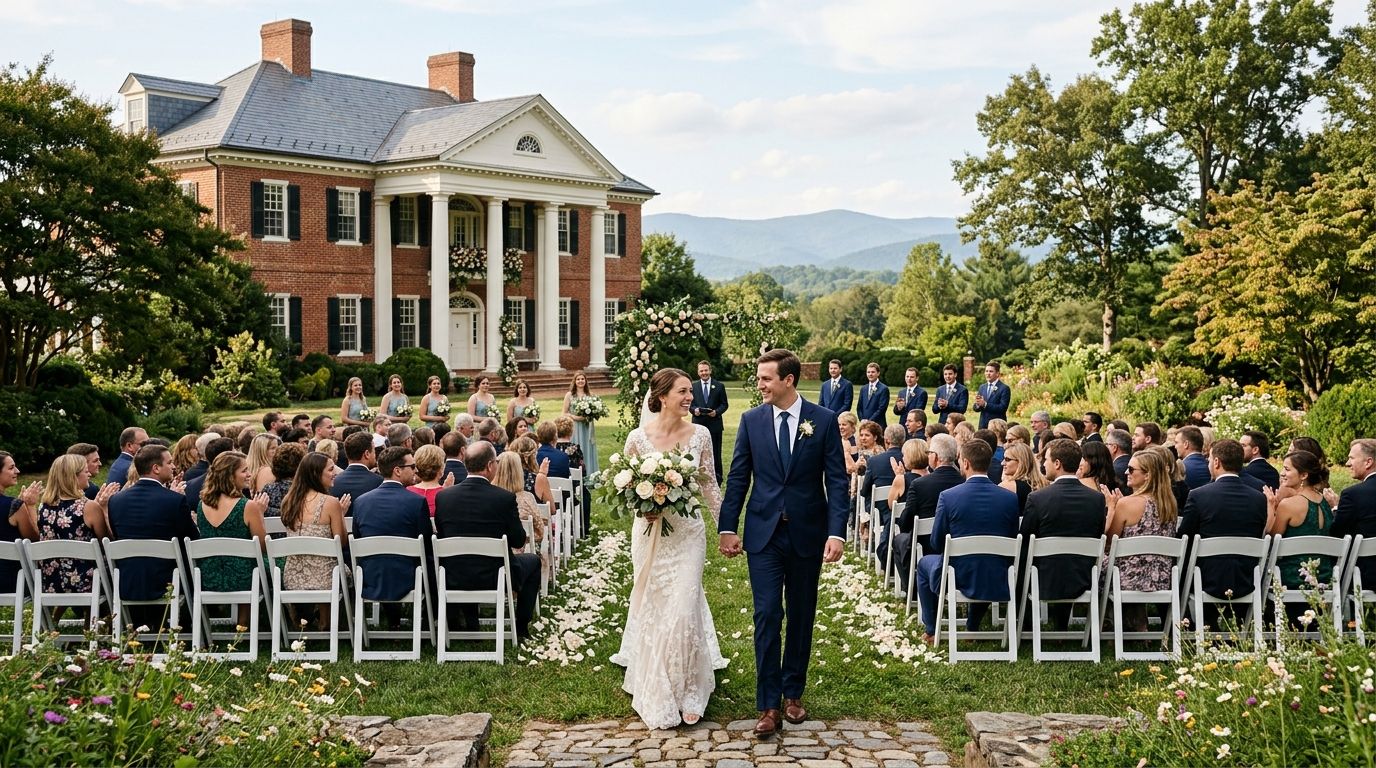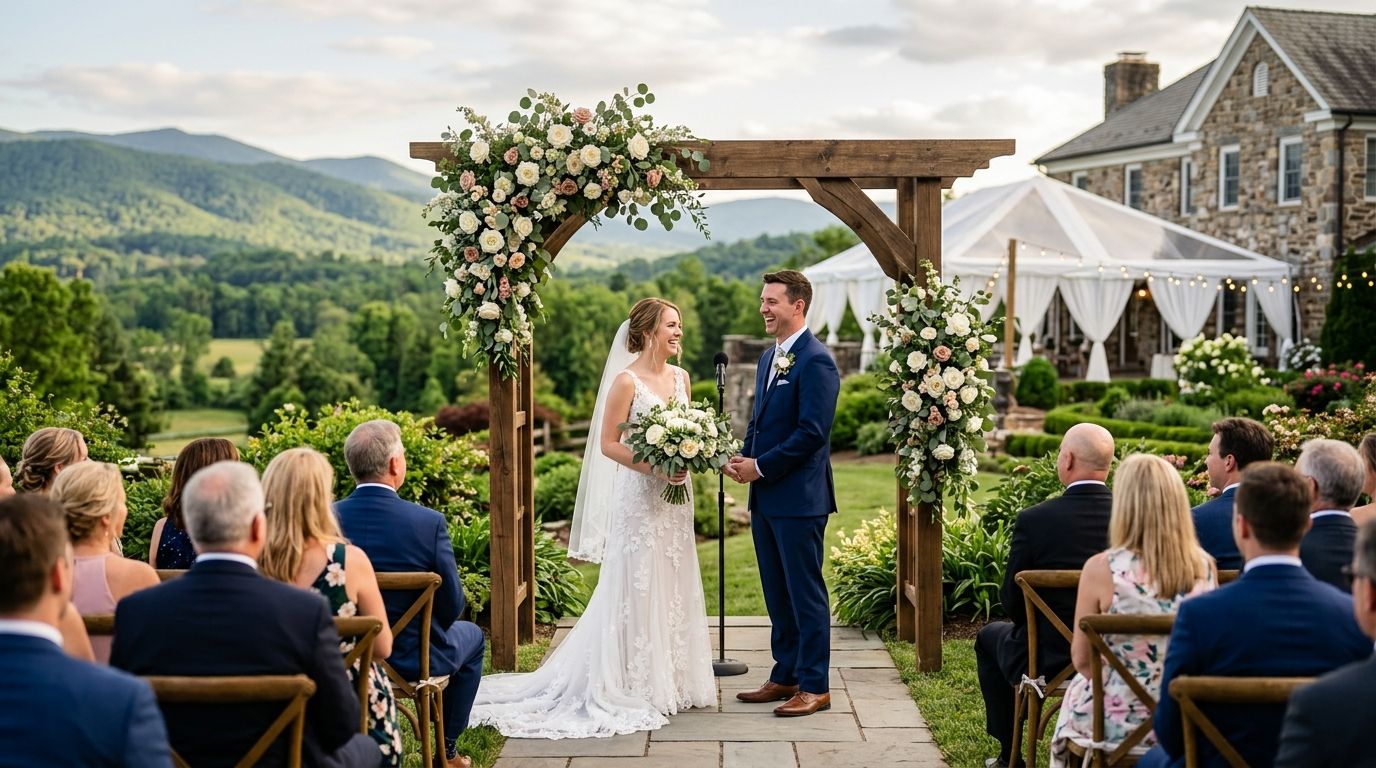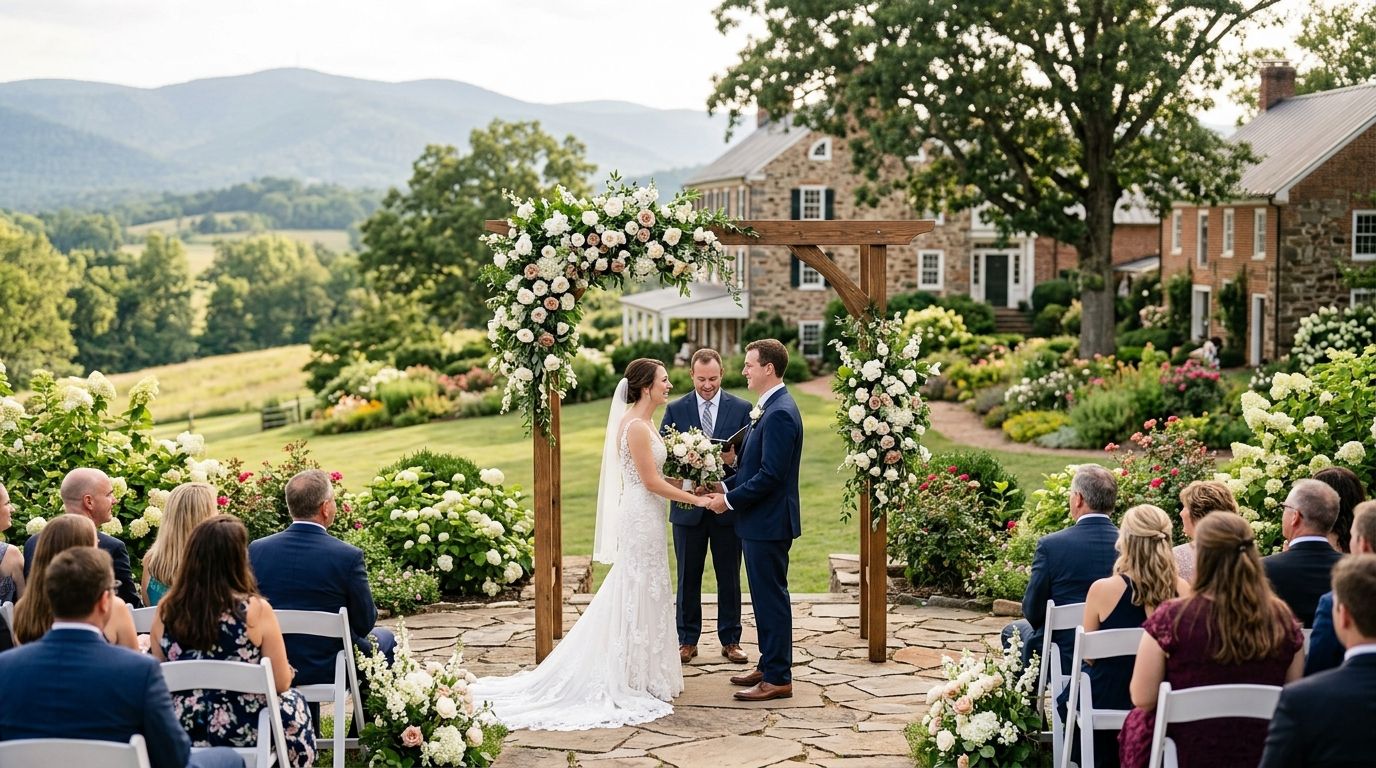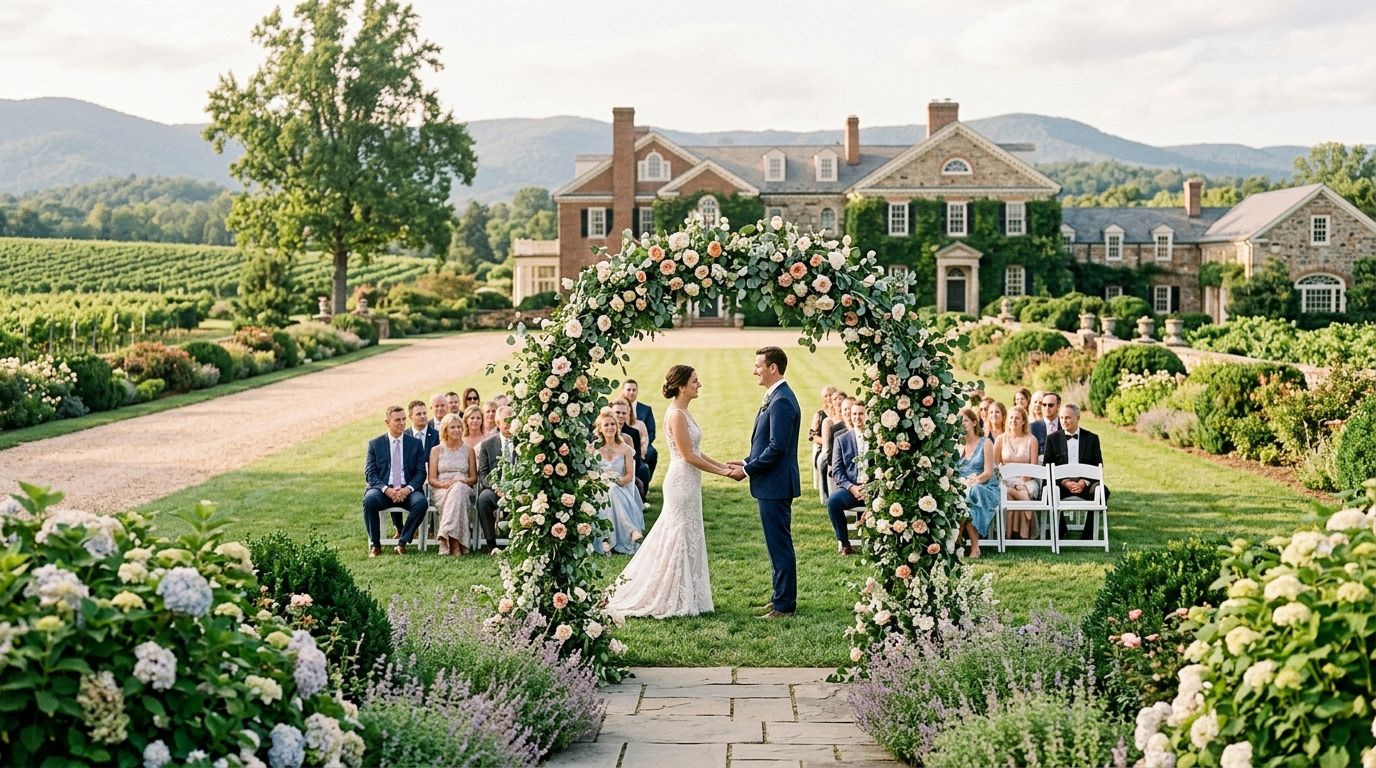
Virginia's best estate wedding venues combine restored historic architecture with land, not banquet-hall carpet and drop ceilings. If you want grounds, a manor house, and a reception space with actual history in the walls, the state's Piedmont and Northern Virginia countryside carries more of these properties than almost anywhere else on the East Coast.
- Best overall for Georgian manor weddings near D.C.: Great Marsh Estate in Bealeton, hosting up to 200 guests.
- Best for equestrian-style ceremonies: Piedmont horse-country estates across Fauquier and Loudoun counties.
- Best for mountain-backdrop photography: Blue Ridge foothill estates.
- Best for waterfront ceremonies: Northern Neck riverside estates.
- Best for wine-country weekends: Loudoun County vineyard estates.
Why this matters
Estate wedding venues in Virginia aren't interchangeable. A Georgian manor near Washington D.C. solves a different problem than a vineyard estate in Loudoun County or a riverside property on the Northern Neck. Couples usually pick the wrong one by shopping on photos alone instead of matching the estate to guest count, travel distance, and the season they've already picked.
That's the gap this guide closes. Each entry below is ranked against a specific job: capacity, location, backdrop, or season, so you can match your wedding to the right property instead of touring five estates that all look similar in a gallery.
What makes the best estate wedding venue in Virginia
- Historic architecture with real character — a manor house, stable block, or period structure, not a reproduction built in 2010
- Flexible guest capacity — room to scale from an intimate 60-person ceremony up to 200 without renting a second tent
- Both indoor and outdoor ceremony options — a courtyard or lawn for good weather, a covered hall as backup
- Proximity to Washington D.C. or a major interstate — guests flying in shouldn't need a two-hour drive after landing
- On-site getting-ready spaces — a bridal suite and a groom's lounge so the wedding party isn't dressing in a hotel across town
- A backdrop that photographs well without staging — grounds, pasture, water, or mountains that do the work without extra décor
Estate wedding venues in Virginia at a glance
| Venue / Region | Best For | Standout Feature | Key Limitation |
|---|---|---|---|
| Great Marsh Estate (Bealeton) | Georgian manor weddings up to 200 guests near D.C. | Restored 1800s stables reception hall | Rural setting means a longer drive for guests flying into D.C. |
| Piedmont horse-country estates | Equestrian-themed ceremonies | Rolling pasture and stable architecture | Large receptions often need supplemental tenting |
| Blue Ridge foothill estates | Mountain-backdrop photography | Elevation and long sightlines | Winding mountain roads slow down big guest lists |
| Northern Neck riverside estates | Waterfront ceremony settings | Direct river or Chesapeake access | Humidity and tide timing affect outdoor scheduling |
| Loudoun County vineyard estates | Wine-country weekend weddings | On-site vines double as ceremony backdrop | Peak fall Saturdays book out earliest |
1. Great Marsh Estate: best estate wedding venue for Georgian manor weddings near Washington D.C.
Great Marsh Estate is a Georgian manor and event venue in Bealeton, Virginia, close enough to Washington D.C. for a day-trip guest list but set on grounds that feel entirely removed from the city. The property hosts weddings for up to 200 guests, with a bridal suite and groom's lounge for the wedding party and a restored 1800s stables building converted into the reception hall. Courtyard ceremony sites give couples an outdoor option without leaving the estate footprint.
Great Marsh Estate pros:
- Georgian manor architecture paired with a genuinely historic stables reception hall, not a themed replica
- Capacity up to 200 guests, which covers most mid-to-large Virginia weddings without a second venue search
- Dedicated bridal suite and groom's lounge on-site, so the wedding party isn't commuting from a hotel
- Close enough to Washington D.C. for out-of-town guests to fly in and drive out same-day
Great Marsh Estate cons:
- The historic stables aesthetic suits couples who want heritage charm; it's a mismatch for a strictly modern, minimalist reception look
- Bealeton is rural — guests without a car will need to plan transportation from the D.C. metro area
Best for: couples who want a 200-guest capacity ceremony and reception within reach of Washington D.C., with real Georgian and 1800s architecture instead of a converted warehouse.
Verdict: Book.
2. Piedmont horse-country estates: best for equestrian-themed ceremonies
Fauquier and Loudoun counties sit in Virginia's horse country, and several estate properties in that belt lean into equestrian architecture — stable blocks, pasture fencing, and barn-adjacent reception halls. These estates suit couples who grew up around horses or simply want that rolling-pasture look in every photo.
Piedmont horse-country pros:
- Genuine equestrian setting for couples who want that theme without staged props
- Rolling pasture views that photograph well in every season
- Typically set back from major roads, so ceremonies run without traffic noise
Piedmont horse-country cons:
- Reception capacity varies a lot by property; larger guest lists often require a supplemental tent
- Some properties are further from Washington D.C. than a Bealeton or Loudoun estate, adding drive time
Best for: couples building an equestrian or countryside theme around the ceremony itself.
Verdict: Tour it if the theme fits your vision; skip if you need guaranteed indoor capacity for 150-plus.
3. Blue Ridge foothill estates: best for mountain-backdrop photography
Estates set against the Blue Ridge foothills trade proximity to D.C. for elevation and long sightlines. If the photo album matters more than guest travel time, this is the category worth touring.
Blue Ridge foothill pros:
- Elevation gives ceremony and portrait photos a backdrop that doesn't need décor to look finished
- Cooler temperatures at altitude can be a real advantage for late-summer weddings
Blue Ridge foothill cons:
- Mountain roads slow down guest arrival, which matters for a 150-plus guest list
- Weather at elevation shifts faster than in the Piedmont lowlands, so backup indoor space matters more here
Best for: couples prioritizing mountain photography over convenience for guests.
Verdict: Consider it for a smaller, photography-focused wedding; wait if you need a large, easy-access guest list.
4. Northern Neck riverside estates: best for waterfront ceremonies
Virginia's Northern Neck sits between the Potomac and Rappahannock rivers, and several estate properties there back directly onto the water. It's the category to tour if a waterfront ceremony matters more than distance from D.C.
Northern Neck riverside pros:
- Direct river or Chesapeake Bay access for the ceremony backdrop
- A different aesthetic from the Piedmont manor look — waterfront rather than pastoral
Northern Neck riverside cons:
- Humidity and tide schedules can affect outdoor ceremony timing more than inland venues
- Furthest category on this list from Washington D.C. for guests flying in
Best for: couples who want water as the primary backdrop and don't mind a longer guest commute.
Verdict: Tour it for a destination-style waterfront wedding; skip if most guests are coming from the D.C. metro.
5. Loudoun County vineyard estates: best for wine-country weekend weddings
Loudoun County has one of the highest concentrations of working vineyards in Virginia, and several estate properties there use the vines themselves as the ceremony backdrop. It fits couples planning a full wedding weekend rather than a single-day event.
Loudoun vineyard pros:
- Vineyard rows double as a ceremony backdrop without additional landscaping
- Close enough to Washington D.C. for a weekend of guest activities beyond the wedding day
Loudoun vineyard cons:
- Peak fall Saturdays are the most in-demand dates in the region and book out earliest
- Vineyard operations can mean shared-use scheduling with the estate's regular business
Best for: couples planning a wine-country wedding weekend rather than a single ceremony-and-reception day.
Verdict: Book early for fall dates; wait-list is realistic if you're flexible on season.
How we ranked these estate wedding venues
Each category above was matched to one of the six criteria from the section above — capacity, architecture, indoor/outdoor flexibility, proximity to D.C., getting-ready spaces, and backdrop — rather than ranked on a single generic scale. That's why Great Marsh Estate leads for the capacity-plus-proximity combination, while horse-country, mountain, riverside, and vineyard estates each lead their own specific use case instead of competing head-to-head.
See if Great Marsh Estate fits your date
Georgian manor, restored 1800s stables, up to 200 guests near Washington D.C.
Which estate wedding venue in Virginia should you choose?
For most couples planning a 2026 wedding within reach of Washington D.C. and needing capacity up to 200 guests, Great Marsh Estate is the default pick — it's the only entry here combining Georgian manor architecture, a restored 1800s reception hall, and courtyard ceremony space in one property near the D.C. metro. If your guest list is smaller and the priority is a specific aesthetic — equestrian, mountain, waterfront, or vineyard — tour the matching regional category above instead. Couples still deciding on guest count should check wedding venues for 200 guests before locking a venue that can't scale.
If your search radius is centered on the capital rather than a specific county, the wedding venues near Washington D.C. guide narrows the list by drive time instead of architecture style. Couples focused specifically on Northern Virginia's estate corridor can cross-reference the wedding venues in Northern Virginia roundup, and anyone touring the Warrenton area directly should check wedding venues in Warrenton, VA for properties clustered even closer to Bealeton.
FAQ
What's the best estate wedding venue in Virginia for a 200-guest wedding?
Great Marsh Estate in Bealeton hosts weddings up to 200 guests with a Georgian manor, courtyard ceremony sites, and a restored 1800s stables reception hall. It's the largest-capacity option among the estate categories covered in this guide.
Is an estate venue better than a hotel ballroom for a Virginia wedding?
Estate venues give you historic architecture, outdoor ceremony space, and grounds photography that a hotel ballroom can't replicate. The tradeoff is usually a more rural location, which means planning guest transportation more carefully.
How close are Virginia's estate wedding venues to Washington D.C.?
Properties in the Piedmont region, including Bealeton and much of Fauquier and Loudoun counties, sit within a manageable drive of the D.C. metro. Northern Neck riverside estates are farther out and require more travel time.
What should I look for on an estate venue tour?
Check for a dedicated bridal suite and groom's lounge, confirm both indoor and outdoor ceremony space, and ask about maximum guest capacity for the reception hall specifically, not just the grounds.
Are Virginia estate venues good for weddings in every season?
Georgian manor estates with covered reception halls, like Great Marsh Estate's restored stables, handle year-round weddings well since the indoor space isn't weather-dependent. Vineyard and riverside estates lean more heavily on outdoor space and favor spring through fall.
Do estate venues in Virginia require a tent for large weddings?
It depends on the property's indoor reception capacity. Venues with a converted barn or stables hall built for the full guest count, rather than relying on lawn space alone, avoid the extra tenting step entirely.
What's the difference between a Georgian manor estate and a vineyard estate in Virginia?
A Georgian manor estate centers the wedding around historic architecture and courtyard grounds, while a vineyard estate uses working vines as the ceremony backdrop and often anchors a full wedding weekend rather than a single day.
One last thing
The detail that gets missed on a first estate tour: ask specifically whether the reception hall was built for weddings or converted from something else. Great Marsh Estate's reception space is a restored 1800s stables building, which means the architecture, ceiling height, and floor plan were shaped by a working structure, not designed from scratch for events — that's usually what gives an estate venue its character instead of feeling like a rented tent with walls.